In Short
- Build the framework around six blocks: decisions, metrics, data, people, tools and governance.
- Start with the decisions your company makes, then work backward to the data and tools that support them.
- Write the framework on two pages, so leaders read it and teams can apply it.
- Test it with a checklist and a yearly review, because priorities and data sources change.
Most analytics strategies fail quietly. They begin as a slide deck full of ambition, drift into a tool project and end as a set of dashboards that few people trust. A framework helps because it forces a short list of choices before any money is spent. If you work with an analytics strategy consulting partner, this is the structure you should see in the first month.
Below I explain the six building blocks I use with clients, how they depend on each other and where teams usually get stuck. I also compare three common ways to organize the work and give you a checklist to test your own plan.
What an Analytics Strategy Framework Actually Contains
A framework is a set of decisions made once and written down, so teams stop re-deciding them in every project. It answers six questions. Which business decisions should data support? Which metrics describe those decisions? Where does the data come from? Who is responsible for it? Which tools carry it? And what rules keep it trustworthy?
Notice what is missing from that list: a vision statement and a maturity score. Both can be useful in a workshop, but neither tells a team what to build on Monday. I keep the framework short on purpose. Every block should produce something concrete, such as a ranked list, a named owner or a one-page rule.
| Building block | The question behind it | What you write down |
|---|---|---|
| 1. Decisions | What will the numbers change? | A ranked list of 5 to 10 decisions with an owner |
| 2. Metrics | How do we measure each decision? | A dictionary with one definition per metric |
| 3. Data | Where do the inputs live? | A source map with quality notes |
| 4. People | Who builds, owns and uses it? | Roles, hours and a request process |
| 5. Tools | What carries the data to the user? | A short stack list with reasons |
| 6. Governance | What keeps it trusted? | Access, certification and change rules |
Block 1: Start With the Decisions
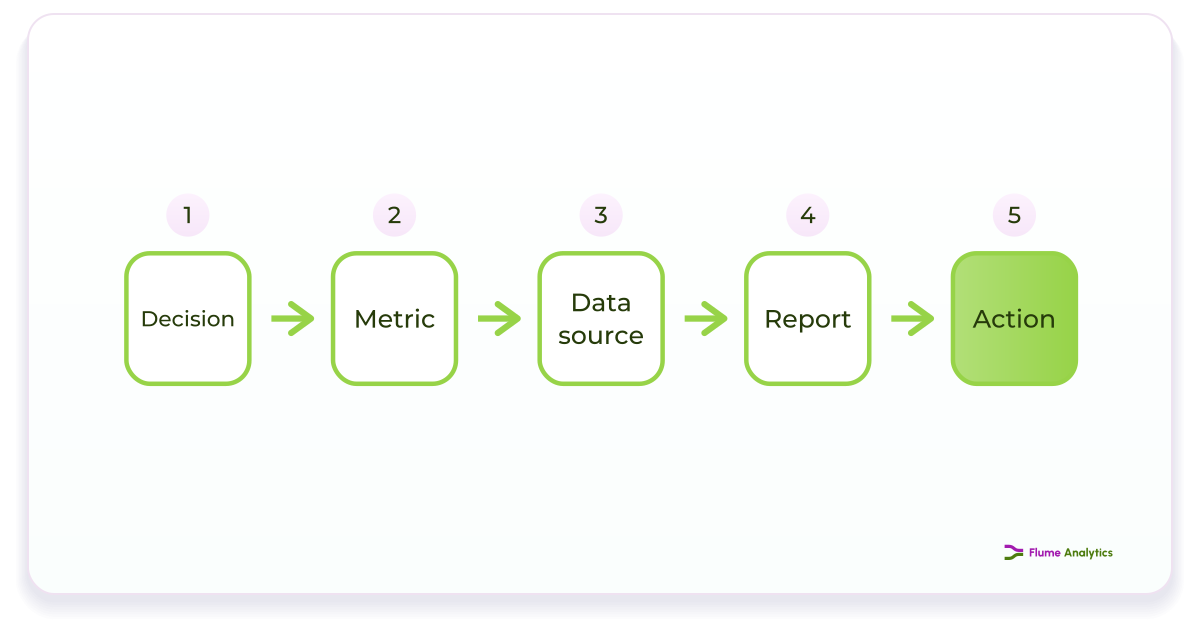
Every strong strategy I have seen begins with a list of decisions. A retailer might list how much stock to buy for each region, which stores get extra staff and which promotions to repeat. A software company might list which accounts need attention before renewal and which features deserve more engineering time.
Run two or three interviews with leaders in different departments and ask one question: what did you decide last quarter that you wish you had better numbers for? The answers give you a realistic list in a few days. Rank it by value and by how often the decision repeats. A monthly decision worth a large budget beats a one-off decision every time.
Block 2: Pin Down the Metrics
Once the decisions are clear, define the few metrics that describe them. This is where most of the arguments hide. Revenue before or after refunds? An active customer in the last 30 days or the last 90? Two teams will answer differently and both will believe they are right.
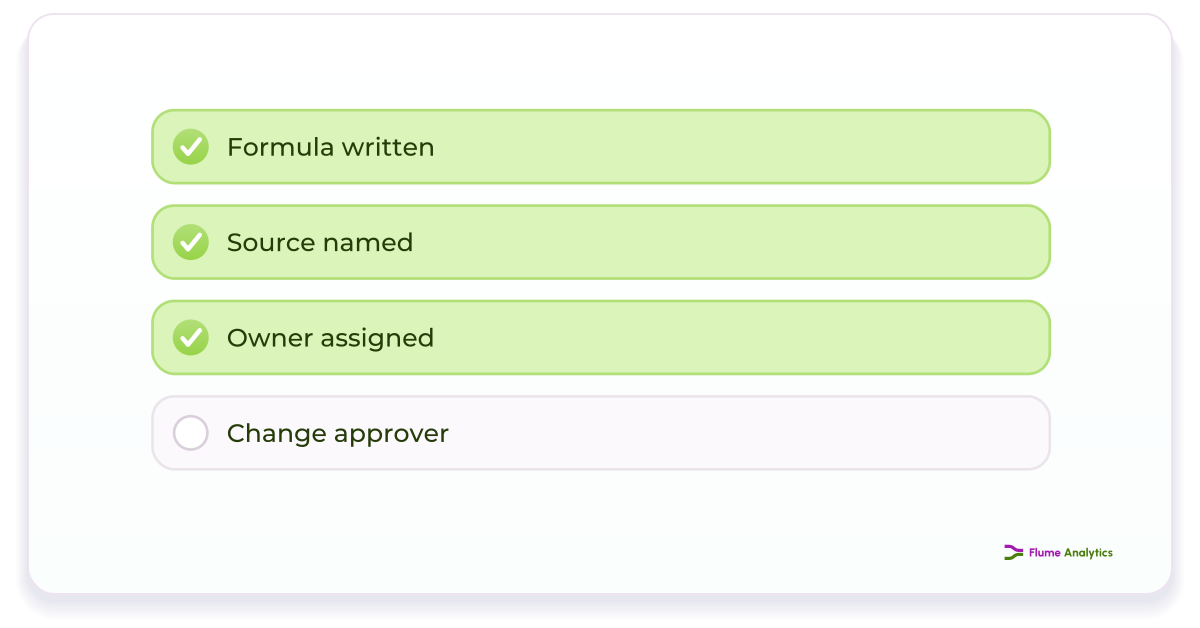
Write each definition once, with a formula, a source, an owner and the date it was agreed. Keep the dictionary short at the start. Fifteen well-defined metrics serve a company better than a hundred loose ones. When you are ready to choose which to track, my list of business intelligence KPIs gives you a sensible starting set.
Block 3: Map the Data You Need
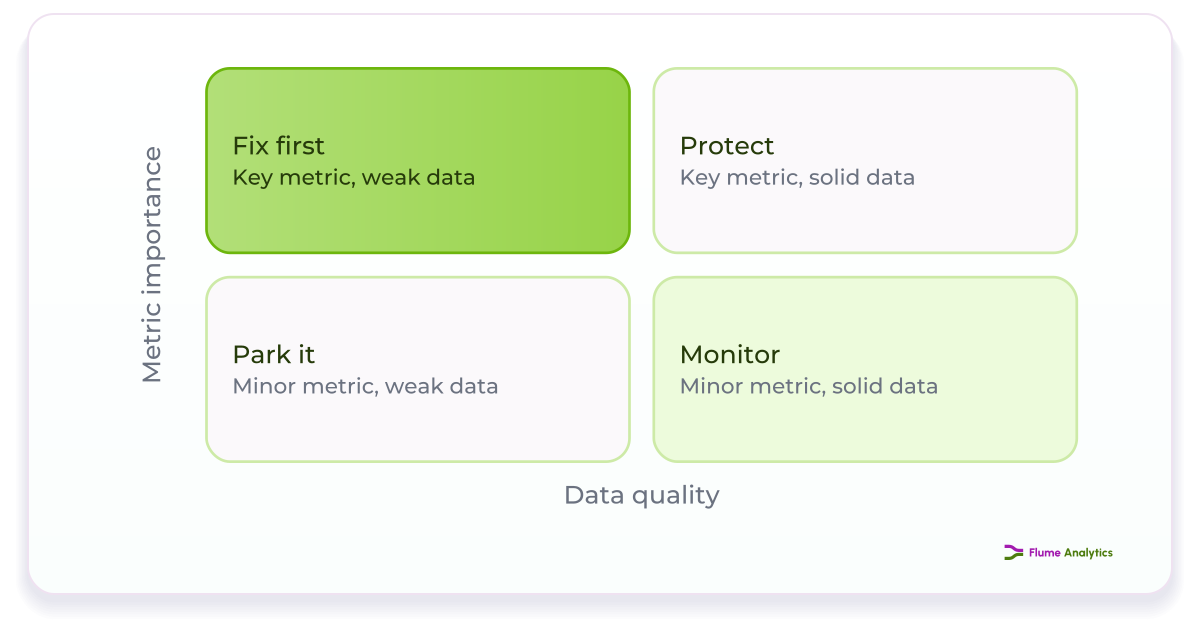
Now go looking for the inputs. List every source behind your first metrics: the shop platform, the CRM, the ad accounts, the billing system, the product database. Next to each, note how fresh it is, how complete it is and who can explain its quirks.
This map almost always shows two problems. First, a metric depends on a source nobody maintains, such as a spreadsheet kept by one person. Second, two sources disagree about the same thing, such as order counts in the shop and in finance. Both are cheaper to find in a planning week than in a launch week.
Block 4: Decide Who Does What
People decide whether the framework survives. Name a business owner for each decision, an analytics lead for the framework itself and a technical owner for each source. Then add hours. A named owner with no time is the most common reason strategies stall in month three.
Also write down how requests arrive. A simple form with three fields, the decision, the deadline and the person who will use the answer, removes most of the rework I see. Analysts stop guessing and managers learn to ask sharper questions. For a view of how a year of work can be sequenced, see my analytics strategy roadmap.
Block 5: Choose Tools Last, and Briefly
Tools come fifth for a reason. When teams start with the tool, they shape the decisions around its features. When they start with decisions, the shortlist is often obvious. A team with data in Microsoft 365 and a few analysts will land on a different stack than a company with a cloud warehouse and engineers.
Keep this block to a half page: the warehouse or storage layer, the transformation approach, the reporting tool and the way you catch errors. For each, give one sentence of reasoning and a note on what would make you switch. If you are comparing reporting platforms, my ranking of business intelligence tools shows pricing and verified user ratings side by side.
Block 6: Governance Without the Bureaucracy
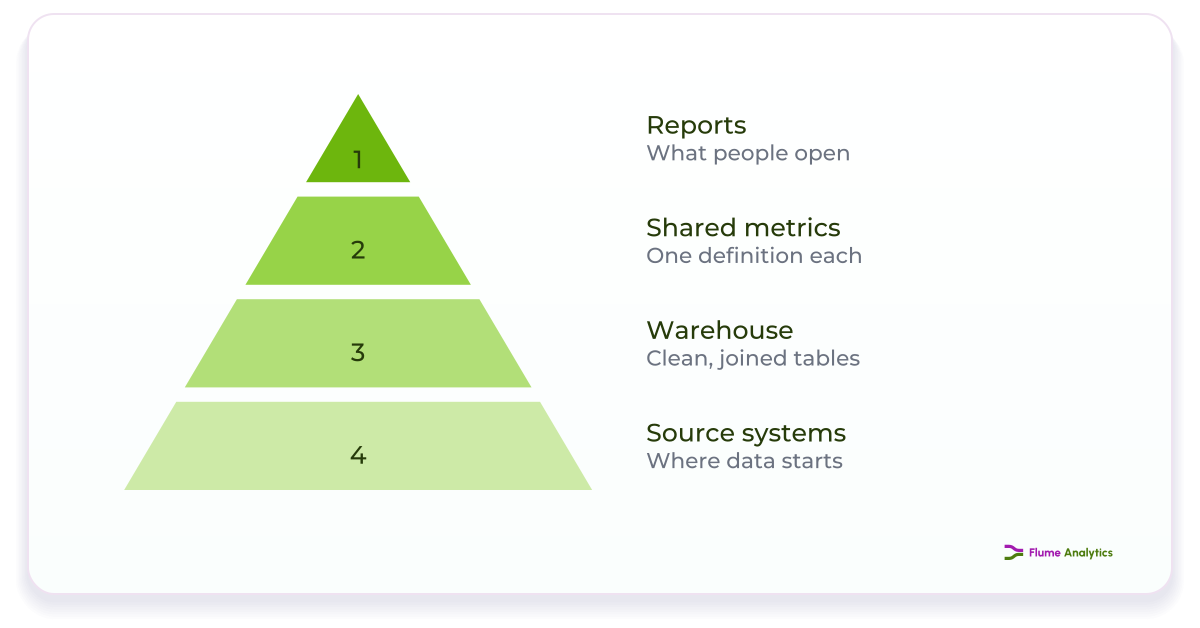
Governance sounds heavy, but a small set of rules does most of the work. Decide who can see sensitive fields, how a report becomes certified, who approves a change to a metric and how long old reports stay alive. Four rules, written in plain language, beat a forty-page policy that nobody reads.
A certification label on reports is one of the cheapest controls I know. Certified means the numbers match the dictionary and the owner has signed off. Everything else is labeled exploratory. People quickly learn which to bring to a board meeting.
Three Ways to Organize the Framework
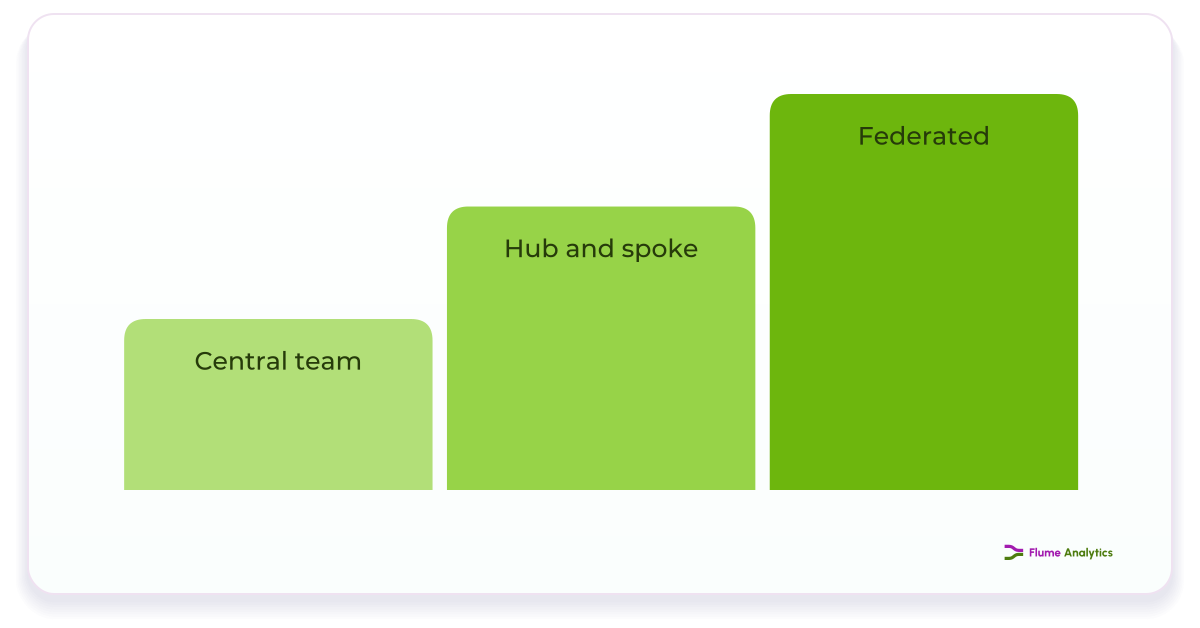
The six blocks stay the same, but companies organize the work around them in different ways. I see three patterns, and each fits a different company.
| Approach | How it works | Best for | Main risk |
|---|---|---|---|
| Central team | One analytics team owns every block | Companies under 300 people | A request queue that grows without limit |
| Hub and spoke | A central team owns data and governance, departments own decisions | Mid-sized companies with several business units | Departments building duplicate reports |
| Federated | Each unit runs its own analytics under shared rules | Large or multi-brand groups | Definitions drifting between units |
Most companies I work with start central, move to hub and spoke around 300 to 500 employees and rarely need the federated model. Pick the lightest one that fits today and revisit when headcount or the number of business units doubles.
Where Frameworks Go Wrong
Frameworks rarely fail because a block is missing. They fail in how the blocks are handled. One common problem is writing the framework as a deck for the board and never turning it into working rules. Another is treating the blocks as a sequence and finishing each in turn, which delays any visible result by months.
A better pattern is to draft all six blocks in a rough form during the first two weeks, then deepen each one while a pilot report is built. The pilot tests the framework against real data, and the lessons feed back into the dictionary, the source map and the ownership list.
A third trap is a metric dictionary that no tool enforces. If the definitions live in a document and the dashboards calculate their own versions, the dictionary is decoration. Put the logic in a shared model or semantic layer, and point every report at it. Real examples of how teams handled this are collected in my article on analytics strategy examples.
Checklist: Is Your Framework Ready to Use?
Run this list before you present the framework to leadership. If you cannot tick an item, that is your next task.
- Five to ten decisions are ranked, each with a named business owner.
- Each decision has one to three metrics with a written definition.
- Every source behind those metrics is mapped, with a quality note and a technical owner.
- Roles have weekly hours agreed with their managers.
- The tool list fits on half a page and explains each choice.
- Certification, access and change rules are written in plain language.
- The whole framework fits on two pages and has a review date.
Use the result as a conversation starter, not a verdict. Two or three gaps in a first draft are normal, and a short list of gaps with owners is more convincing to leadership than a spotless but untested plan.
How to Pick the Starting Point for Your Company
Where you begin depends on what is already in place. If your reports exist but nobody trusts them, start with blocks two and six, the dictionary and the certification rules. If you have strong data but weak adoption, start with block one and interview the people who should be using it. If you have neither, begin with the decisions, then build a single pilot report that proves the chain from source to choice.
Whatever you choose, set a review date. Business priorities move, new data sources appear and people leave. A framework that is reviewed every year stays useful, and one that is not becomes the next outdated document on a shared drive. Keep your review light: reread the decisions list, retire what no longer matters and check that each owner is still in place.
Questions About Your Analytics Strategy Framework
What Is an Analytics Strategy Framework?
It is a short, structured way to decide what your company will measure, which decisions the numbers will support, who owns them and what it takes to deliver them. Most frameworks have five or six building blocks, and the useful ones fit on two pages.
How Is an Analytics Strategy Different from a Data Strategy?
A data strategy covers how you collect, store and protect data. An analytics strategy covers how you turn that data into decisions. They overlap, and the analytics side should drive the data side, because the decisions tell you which data matters.
How Long Does It Take to Build the Framework?
A first version takes two to four weeks for a mid-sized company, mostly spent on interviews with decision makers and a review of current reports. Plan a yearly refresh and a lighter check every quarter.
Who Should Own the Analytics Strategy?
A senior business leader should own it, with an analytics lead running it day to day. When it sits only inside IT or only inside one department, it tends to serve that group and nobody else.
Do I Need a Framework If I Have Only a Few Dashboards?
A light version still helps. Write down the five decisions your dashboards should support and the owner of each. That one page keeps a small setup from turning into a pile of reports nobody trusts.
Which Building Block Should I Fix First?
Start with decisions. If you cannot name the choices a report will change, no amount of tooling or modeling will rescue it. Next comes ownership, because someone has to settle definitions when two teams disagree.
How Do I Show That the Strategy Works?
Track three things each quarter: the share of key decisions that use a certified report, the time from question to answer and the number of disputes about metric definitions. Falling disputes and faster answers are early signs it is working.
Important: nothing in this article is legal, financial or tax advice. All figures are estimates from typical projects, so verify them with your own providers and advisers.
Was this useful?
We appreciate the feedback.
Rosalind Tierney
Rosalind leads the Flume editorial team and works with our consultants to turn real client projects into practical guides on dashboards, tracking, experimentation and machine learning. Before joining Flume, she spent 11 years in analytics and business intelligence roles. She has since edited more than 300 articles on analytics practice and reviewed dashboards, tracking plans and analytics audits from over 100 client projects. She is based in Minneapolis, Minnesota.