In Short
- A framework has five pillars: decisions, data, models, delivery and governance. Skipping any one of them is where projects stall.
- Name one owner per pillar. Shared ownership of a model usually means nobody checks it after launch.
- A monthly review rhythm keeps live models accurate and shows leaders what the work is worth.
- Start with one decision and one model, then let the framework grow from what that project teaches you.
Most companies that struggle with models do not have a modeling problem. They have a handoff problem. A data scientist builds a churn model, the business changes its process, the data feed shifts and six months later nobody can say whether the scores still mean anything. A framework fixes that by deciding, in advance, who owns each piece and when it gets checked. It is the first thing I put in place during advanced analytics consulting work, before any tool is chosen.
Below is the structure I use with clients: five pillars, the roles that own them and a rhythm you can keep up with a small team. It is deliberately short. A framework you can explain in five minutes is one your colleagues will follow.
What an Advanced Analytics Framework Covers
Advanced analytics is the work that goes beyond reporting: forecasting, classification, segmentation, optimization and experimentation. A framework does not tell you which algorithm to use. It sets the rules around the algorithms, so that results are trustworthy, reusable and tied to a decision someone is accountable for.
I think of it as answering six questions in writing. Which decisions are we trying to improve? Where does the data come from, and who vouches for it? How are models built and tested? How do outputs reach the people who act on them? Who checks that a live model is still right? And how do we decide what to work on next? If your team cannot answer all six in a single meeting, you have found your first piece of work.
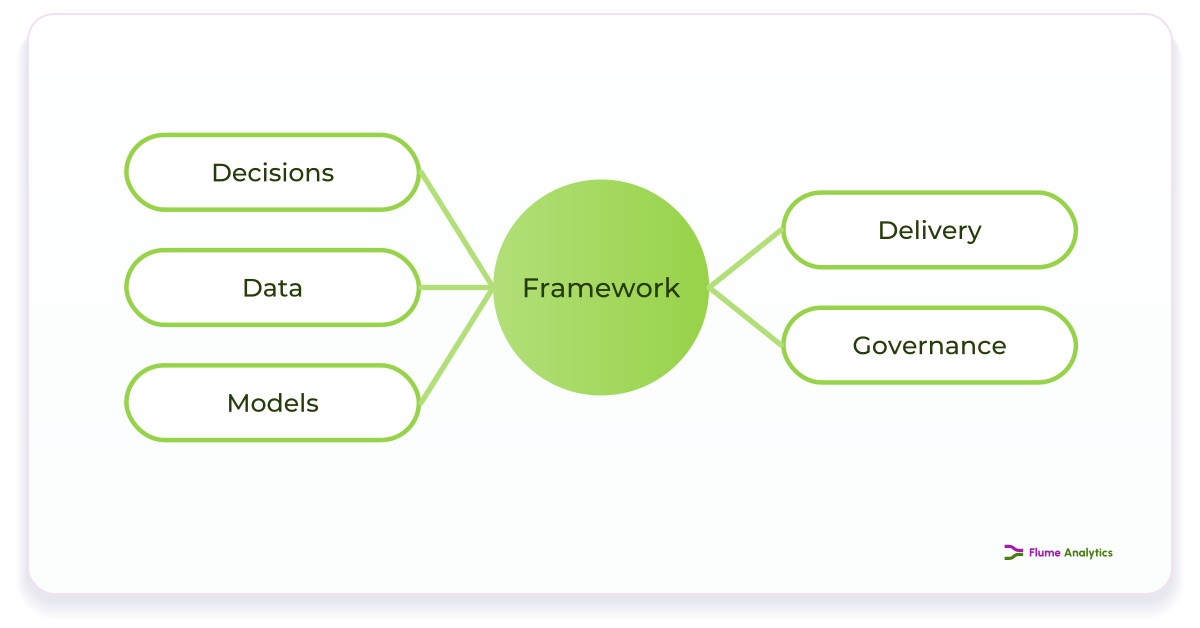
| Pillar | The question behind it | Typical owner | Minimum written output |
|---|---|---|---|
| Decisions | What are we improving, and what is it worth? | Business lead | A ranked list of decisions with a rough value for each |
| Data | Can we trust the inputs? | Data engineer | A short data contract per source: fields, refresh time, known gaps |
| Models | How do we build and test? | Data scientist | A model card with purpose, inputs, baseline and accuracy |
| Delivery | How do results reach the person who acts? | Analytics engineer or product owner | A named destination: CRM field, dashboard, alert or report |
| Governance | Who checks it stays right and safe? | Analytics lead | A monthly review checklist and an access and privacy note |
Pillar One: Start With the Decision
Every model should point at a decision, and the decision should have a name. "Improve retention" is a goal. "Decide which 200 accounts the customer success team calls each week" is a decision. The second version tells you what the model has to output, how accurate it needs to be and who will act on it. Models built for a goal usually end up as interesting charts.
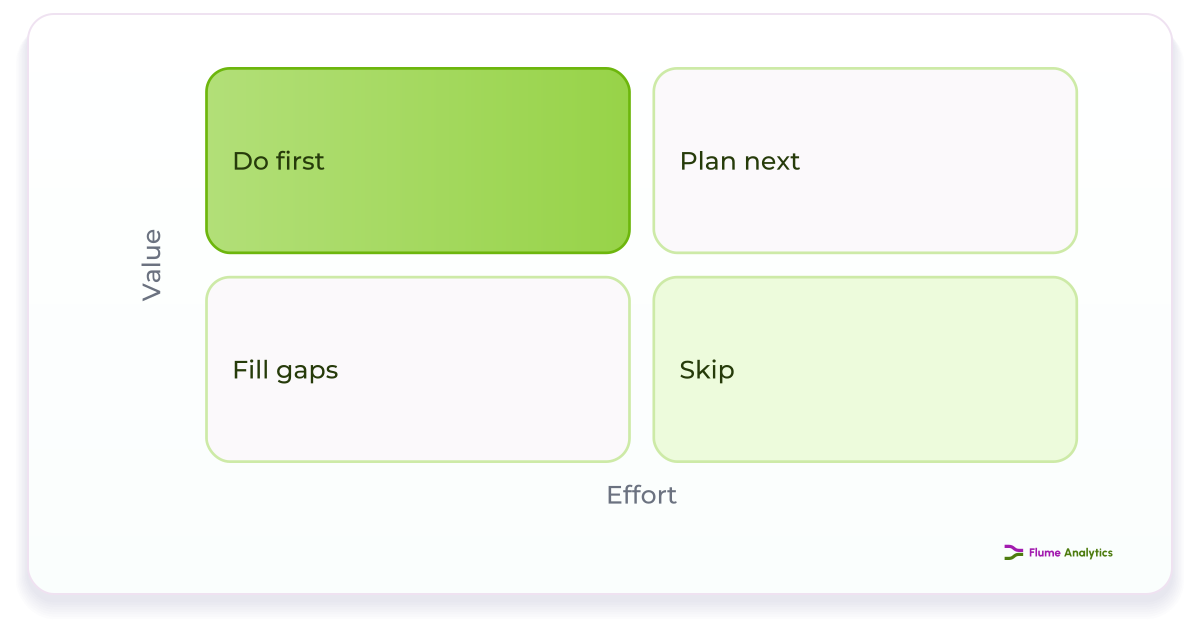
To rank candidate decisions, I score them on four things: how often the decision is made, what a wrong call costs, whether usable data exists today and whether someone has the authority to change behavior. A decision made twice a year rarely justifies a pipeline. One made every day in a call center often does. I walk through nine scored examples in my guide to advanced analytics use cases, which is a good place to find candidates.
Pillar Two: Agree on the Data Before the Model
I have seen more modeling projects lose a month to data disputes than to any technical problem. Two systems define an active customer differently, a field is filled in by hand, a feed arrives late on Mondays. A model trained on that mess learns the mess. The data pillar is where you write these facts down before they hurt you.
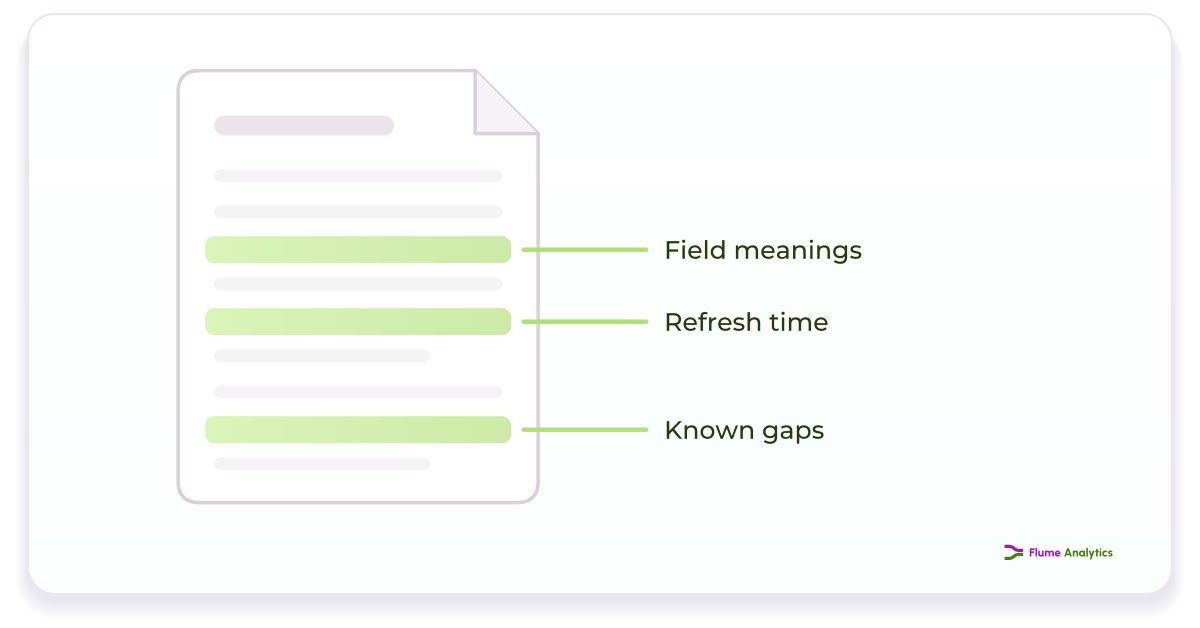
For each source, keep a half-page data contract: what the fields mean, how fresh they are, who fixes them when they break and what is known to be wrong. That is enough. You do not need a catalog product to start. You need a shared document that an engineer updates when something changes and a rule that models only read from sources that have one.
Treat features the same way. When two models both need "orders in the last 90 days", compute it once, test it once and reuse it. Teams that skip this end up with four slightly different versions of the same number, and a leader asking why the churn model and the finance report disagree.
Pillar Three: Build Models Like Products
A model that only runs on its author's laptop is a prototype. The models pillar sets the minimum bar for moving from prototype to something the business relies on. Mine has four rules.
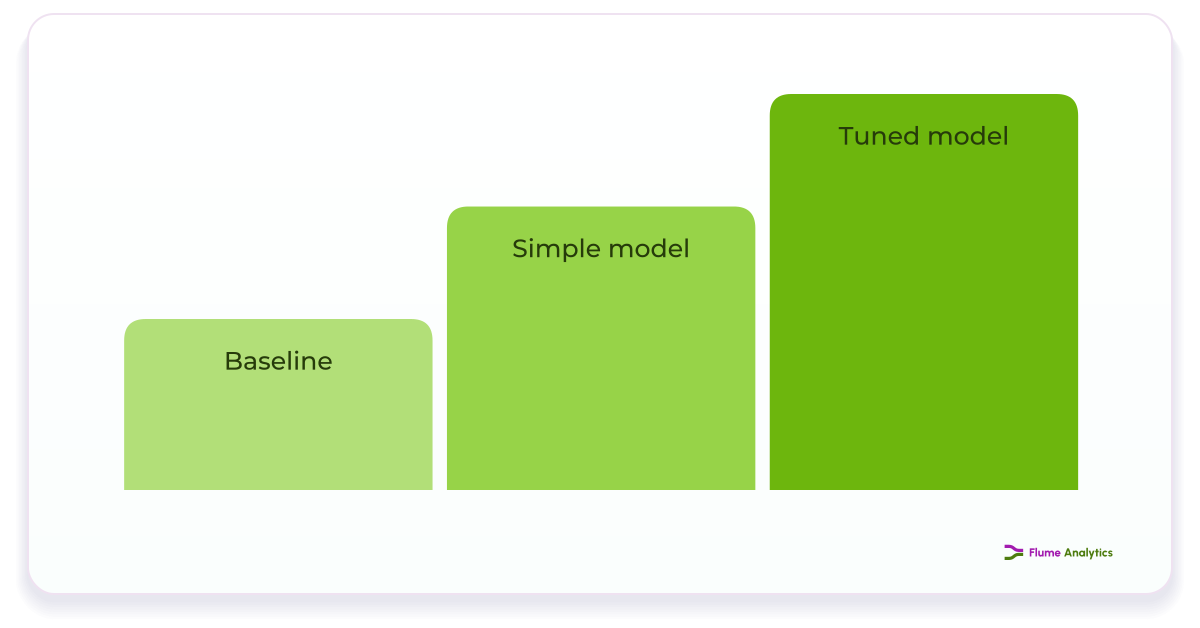
- Every model beats a simple baseline, such as last period's value or a plain average, and the comparison is written down.
- Every model has a model card: purpose, training data, known weak spots, owner and retraining plan.
- Code and parameters live in version control, so you can reproduce last quarter's result.
- Accuracy is measured on data the model did not see, in a time window that matches how it will be used.
The baseline rule is the one teams resist and later thank me for. On one retail forecasting project, the fancy model beat last year's sales by under two percent, and a simple seasonal average was nearly as good. We shipped the simple one, kept the complex one in reserve and spent the saved effort on delivery. Your tool choice matters less than this discipline, but when you do compare options, my ranking of advanced analytics tools covers both machine learning and statistics platforms.
Pillar Four: Put Results Where Decisions Happen
A score in a data warehouse table changes nothing. Delivery is the pillar that decides whether anyone acts on the model. Pick the destination before you build: a field in the CRM, a column in the planning spreadsheet, an alert in the team's chat channel or a number on the dashboard people open every morning.
Keep the output small and explainable. A salesperson will use "likely to renew: low, because usage fell 40 percent in 30 days" and ignore "0.31". Add the top reason or two next to each score, and give the user a way to say the score was wrong. That feedback becomes the best training data you will ever get.
Delivery also covers who handles failures. If the nightly scoring job breaks, someone should get a message before the business notices stale numbers. Assign that person by name.
Pillar Five: Govern Lightly and Often
Governance has a bad reputation because it is often a committee that meets quarterly and blocks things. The version that works is a short checklist run every month on every live model: is accuracy within the agreed range, has the input data shifted, is anyone still using the output, and did anything upstream change? Access and privacy notes sit alongside, covering who can see which fields and how personal data is handled. For rules that apply to your sector, check current requirements with your legal advisers.
Roles: Who Owns What
Titles vary by company, so I define roles by what they own. One person can hold several roles in a small team, but the roles themselves should always exist on paper.
| Role | Owns | Signs off on |
|---|---|---|
| Business owner | The decision and its value | Whether a model is worth building and keeping |
| Data scientist | Model design, testing and the model card | Accuracy against the baseline |
| Data engineer | Pipelines, data contracts and refresh reliability | Data quality for each source |
| Analytics engineer or product owner | Delivery into the tools people use | That outputs are readable and reach the right person |
| Analytics lead | The framework, the review rhythm and the backlog | Priorities and retirement of models nobody uses |
The role companies skip most often is the business owner. Without one, the model team optimizes for accuracy and the business never changes a process. I will not start a project until that person has a name and has agreed to attend the monthly review.
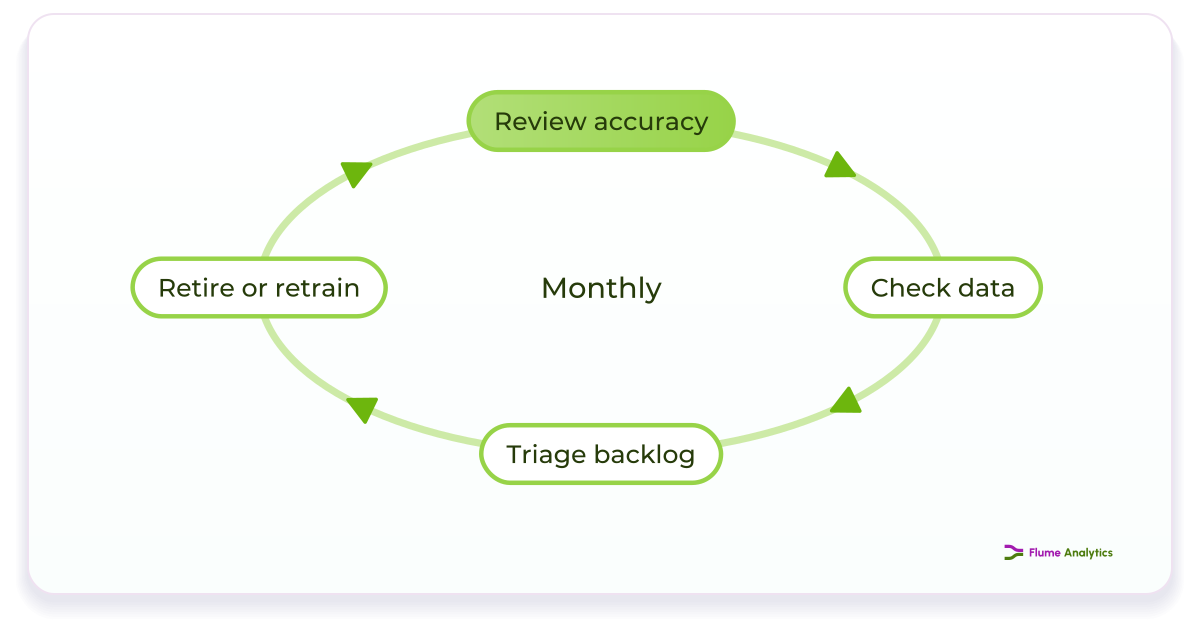
Rhythm: The Monthly Cycle That Keeps It Alive
Rhythm is what separates a framework from a document. Here is the cycle I set up with most clients. It takes about two hours of meeting time a month across the whole team.
- Week one: the analytics engineer checks pipelines and data drift reports for every live model.
- Week two: the data scientist compares predictions with actual outcomes and updates the model cards.
- Week three: the business owner reviews what changed in the decision, with a short written note on value.
- Week four: the analytics lead runs a one-hour review, retires or retrains models and reorders the backlog.
Once a quarter, add a look back: which models earned their keep, which did not, and what that says about the next decisions on the list. When you are ready to turn this into dated milestones, the advanced analytics roadmap lays out a 12-month plan around the same structure. Looking at where the field is moving also helps with prioritizing, and my notes on advanced analytics trends cover the shifts I would plan for.
Adapting the Framework to Your Size
A five-person company and a 5,000-person company need the same five pillars, but the weight differs. Small teams should keep each pillar to a page and let one person hold several roles. Larger organizations usually need shared feature definitions across teams and a central review so that two departments do not build the same model twice.
Regulated industries add a heavier governance pillar: documentation for every model, approval steps before changes and audit trails for who saw what. Retail and SaaS companies tend to need faster delivery and more experimentation, since decisions repeat daily and feedback arrives quickly. Whatever your size, resist copying another company's version. Write the shortest version that answers the six questions for your business, then add detail only when something goes wrong.
A One-Page Checklist to Start With
If you want to begin this week, answer these in a shared document. Anything you cannot answer is your starting list.
- Which three decisions would be worth improving, and what does a wrong call cost today?
- Who is the named business owner for the first one?
- Which data sources feed it, and who fixes them when they break?
- What simple baseline must the first model beat?
- Where will the output appear, and who acts on it?
- When is the first monthly review, and who attends?
Most teams I work with fill this in during a single workshop and discover two or three gaps they did not know they had. Closing those gaps is usually worth more than the first model itself.
Questions About Building an Advanced Analytics Framework
What Is an Advanced Analytics Framework?
It is the written agreement on how your company turns data into modeled answers: which problems you work on, who does what, which tools and data standards you use, and how often results get reviewed. Without it, each model is a one-off project that depends on whoever built it. With it, a second and third model take weeks instead of months because the groundwork already exists.
How Is Advanced Analytics Different from Business Intelligence?
Business intelligence describes what happened, mostly through dashboards and reports. Advanced analytics predicts what will happen or recommends what to do, using statistics, machine learning and optimization. In practice you need both, because models need the clean, agreed metrics that good BI produces, and BI gets more useful when model outputs appear next to the numbers people already trust.
How Many People Do I Need to Start?
Fewer than most teams expect. In my client work, a first model has been delivered by one analyst or data scientist, a part-time data engineer and a business owner who can say what a good answer is worth. The framework matters more than headcount, because it makes clear who owns the data, who owns the model and who owns the decision it supports.
Which Pillar Should I Build First?
Start with the decision pillar. Pick one decision that is made often, has a measurable cost when it goes wrong, and already has data behind it. If you cannot name that decision in one sentence, the data and tooling work will drift. Once the decision is clear, the data, model and delivery pillars have a target to aim at.
How Often Should We Review Models Once They Are Live?
I suggest a light monthly check on accuracy and data drift for every live model, a deeper quarterly review of business value, and an immediate review whenever an upstream system or process changes. A monthly rhythm is frequent enough to catch decay early and light enough that the team will keep doing it.
Do We Need a Data Science Platform Before We Have a Framework?
No. Teams that buy a platform first often end up with an expensive notebook server and no agreed use cases. Write the framework on a few pages, run one model with the tools you already have, and let the real friction tell you which platform features you need. The tool choice gets much easier after that.
What Goes Wrong Most Often with These Frameworks?
They get written as a slide deck and never used. The versions that survive are short, name a person for every role, and are tied to a recurring meeting where models are actually reviewed. If the framework does not change what happens on a Tuesday afternoon, it is documentation, not a framework.
Important: nothing in this article is legal, financial or tax advice. All figures are estimates from typical projects, so verify them with your own providers and advisers.
Was this useful?
We appreciate the feedback.
Rosalind Tierney
Rosalind leads the Flume editorial team and works with our consultants to turn real client projects into practical guides on dashboards, tracking, experimentation and machine learning. Before joining Flume, she spent 11 years in analytics and business intelligence roles. She has since edited more than 300 articles on analytics practice and reviewed dashboards, tracking plans and analytics audits from over 100 client projects. She is based in Minneapolis, Minnesota.