In Short
- Predictive analytics pays off when you repeat the same decision often and someone acts on each score.
- Data preparation and ongoing monitoring cost more than the model itself.
- Models drift, so a named owner and a monthly accuracy check are not optional.
- Test every model against a simple baseline before you invest in a full build.
Predictive analytics uses historical data to estimate what is likely to happen next: which customers will churn, which invoices will be paid late, how many units you will sell next month. Most teams that ask me about it have already seen a convincing demo. Few have a clear picture of what it costs to keep a model useful after launch. If you are weighing a project through predictive analytics consulting, you need both sides of the ledger before you commit budget.
Below I go through the real advantages, the real downsides and the situations where I tell clients to wait. The verdict depends on your data and your decisions more than on the technology, so I finish with a short checklist you can run against your own situation.
What You Are Actually Buying With Predictive Analytics
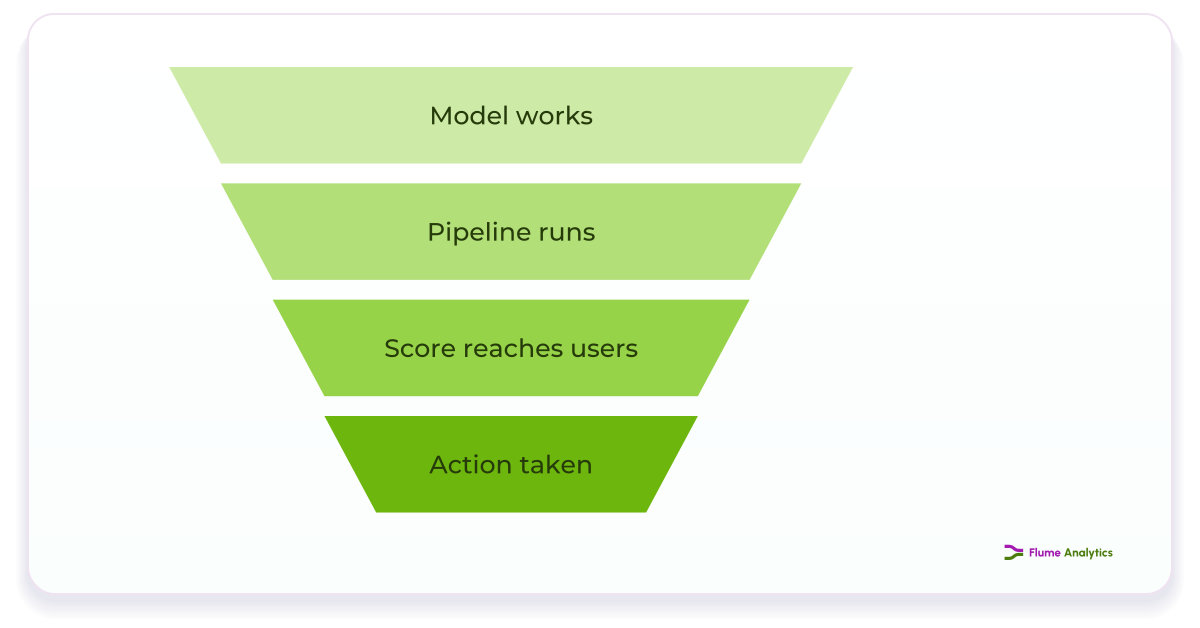
A predictive model takes inputs you already collect, such as order history, product usage, ticket volume or ad spend, and returns a score or a forecast. The score only has value when someone acts on it. A churn score that sits in a notebook changes nothing, while the same score inside the CRM, next to a task for the account owner, can change renewals.
That gap between a working model and a used model is where most of the pros and cons below come from. The table gives you the short version, and the sections after it explain the reasoning.
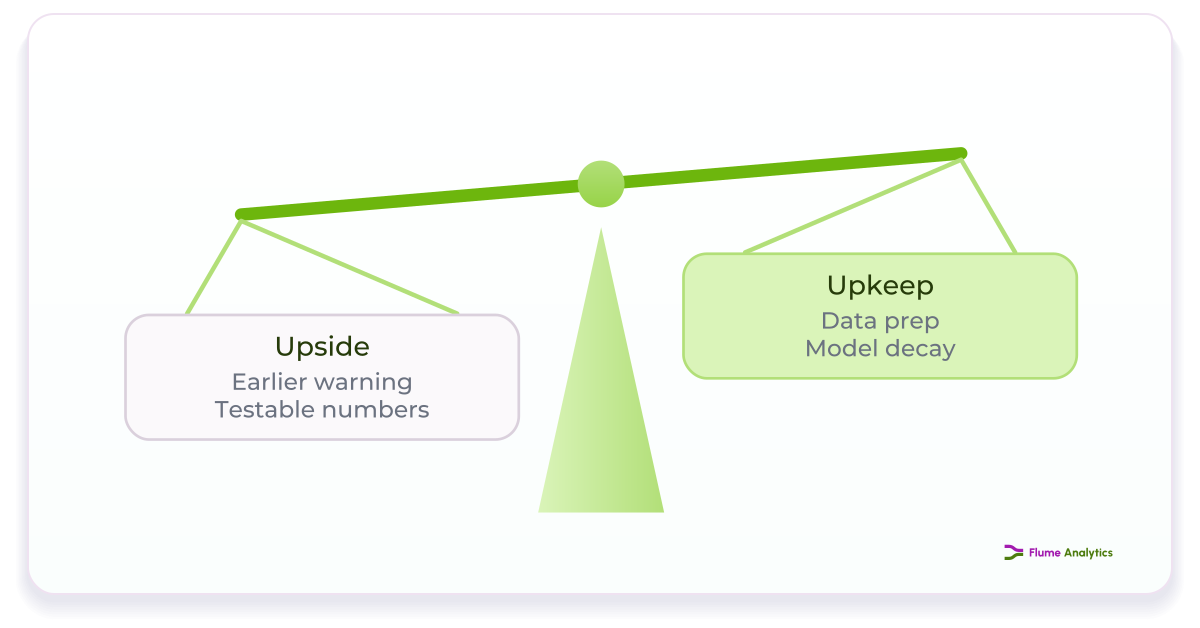
| Area | Pro | Con |
|---|---|---|
| Decisions | Earlier warning on churn, demand and risk, so you act before the outcome | A prediction without an owner or an action changes nothing |
| Cost | Targets spend on the accounts, products or campaigns most likely to respond | Data work, build and monitoring cost more than the model itself |
| Accuracy | Beats gut feel on high-volume decisions with enough history | Weak on rare events, new products and sudden market shifts |
| Speed | Scores refresh automatically once the pipeline runs | Getting to a trusted pipeline usually takes longer than planned |
| Trust | Makes assumptions explicit and testable | Black-box models are hard to explain to sales, finance or regulators |
| Upkeep | Improves as you add cleaner data and feedback | Models drift, so someone has to own retraining and checks |
The Real Advantages of Predictive Analytics
You See Problems Before They Show Up in Revenue
The strongest benefit is timing. A churn model that flags an account six weeks before renewal gives customer success time to call. A demand forecast that spots a seasonal spike gives purchasing time to reorder. Reports tell you what already happened, and a model moves the same data one step earlier.
In my client work, the gain rarely comes from the model being brilliant. It comes from a team finally agreeing on a list of "accounts to call this week" instead of arguing over which dashboard is right.
You Spend Effort Where It Pays
Lead scoring, propensity-to-buy models and next-best-offer logic let you rank thousands of records and give your people the top slice. That matters most when your capacity is limited: a sales team that can call 200 accounts a week should call the 200 most likely to buy. If you have a lot of volume and a small team, this is the most dependable return.
You Replace Argument With a Testable Number
A forecast has an error you can measure. You can compare it to last year's guess, check it against actuals every month and improve it. That discipline alone helps many finance and operations teams, even when the first model is simple. A seasonal baseline and a gradient-boosted model often land closer to each other than people expect, so I start with the baseline and only add complexity when it earns its keep.
The same measurability helps with a structured predictive analytics framework, which turns scattered experiments into a repeatable cycle of question, data, model, action and review.
The Real Downsides You Should Plan For
Data Preparation Eats Most of the Budget
Models need consistent history. If customer IDs differ between your CRM and billing system, or if a tracking change two years ago broke your event history, the first weeks go to repair work. Teams often budget for modeling and discover that cleaning, joining and documenting data is the bigger line item. Ask any vendor what share of a typical project goes to data work. If the answer is small, be careful.
Models Decay Without an Owner
A model trained on last year's customers will slowly get worse as prices, products and buyer behavior change. Without monitoring, nobody notices until a manager asks why scores look odd. Plan for a named owner, a monthly accuracy check and a retraining routine. If you skip that, you are paying for a model that is accurate on launch day and misleading a year later.
Explaining the Score Is Harder Than Producing It
Sales reps ignore scores they do not understand. Finance teams distrust forecasts without assumptions. Simpler models such as logistic regression or shallow trees are easier to explain, and the accuracy you give up is often small. In regulated settings, explainability is not optional, so I weigh it from the start rather than adding it later.
Historical Bias Gets Automated
A model learns from past decisions, including the unfair ones. If you scored job candidates, loan applicants or patients on historical outcomes, you can reproduce old patterns at scale. Check outcomes across groups before launch and keep a human reviewer on decisions that affect people. For the wider list of what can go wrong, see my breakdown of predictive analytics risks.
Rare and New Events Stay Hard
Predictive models learn from repetition. They handle frequent events well and struggle with rare ones, new products or sudden shocks. A launch with no history, a supply disruption or a pricing change that has never happened will not be in the training data. Treat model output as one input and keep a person responsible for the call.
What It Costs and Who Can Afford It
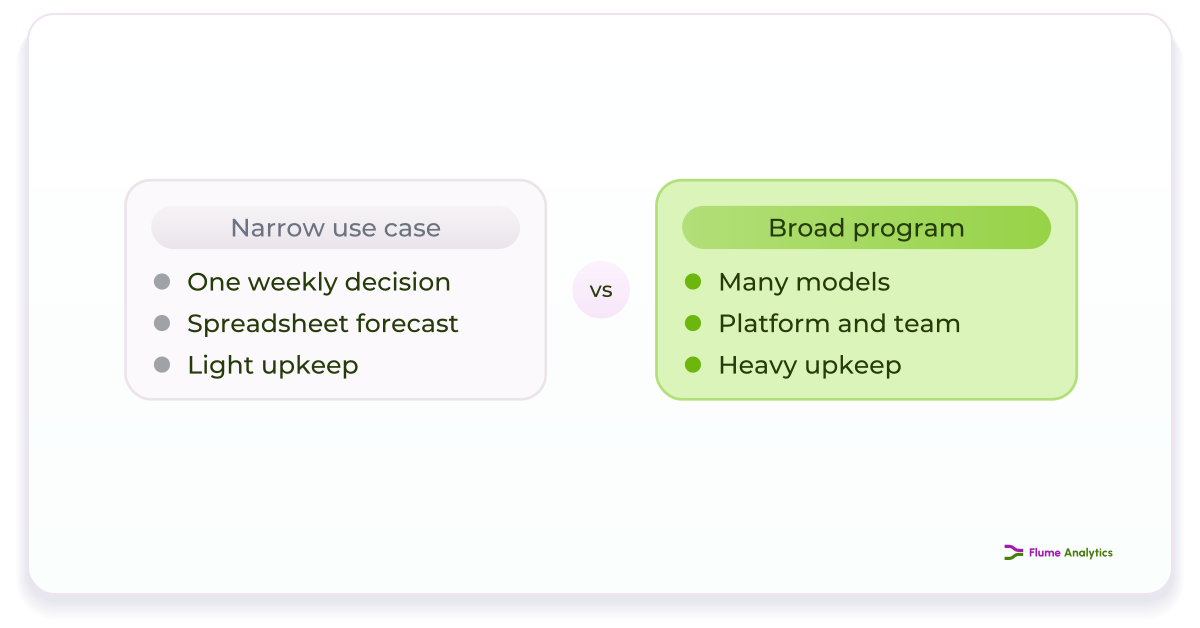
Cost depends on data readiness, the number of models and the level of integration. A single forecast on clean data can be a short project, while a production system with monitoring, scoring pipelines and CRM integration is a program. Software licenses are a small part for most teams. The recurring cost is people: someone has to watch, fix and retrain.
Smaller companies can still benefit if the use case is narrow. A simple churn or demand model built inside tools you already pay for can work well. I cover that path in my guide to predictive analytics for small business, including what to skip. If you are comparing platforms, the ranking of predictive analytics tools shows which ones suit non-technical teams and which need data scientists.
| Situation | My usual advice |
|---|---|
| Under a few thousand records in the history | Use a simple forecast or rules, and revisit when data grows |
| Clean data and a repeated weekly decision | Good fit: build one model, wire it into the workflow |
| Messy data across five systems | Fix tracking and definitions first, model second |
| No one to own the model | Wait, or buy a managed service with monitoring included |
| Regulated or people-affecting decisions | Prefer explainable models and add human review |
When Predictive Analytics Is Worth It
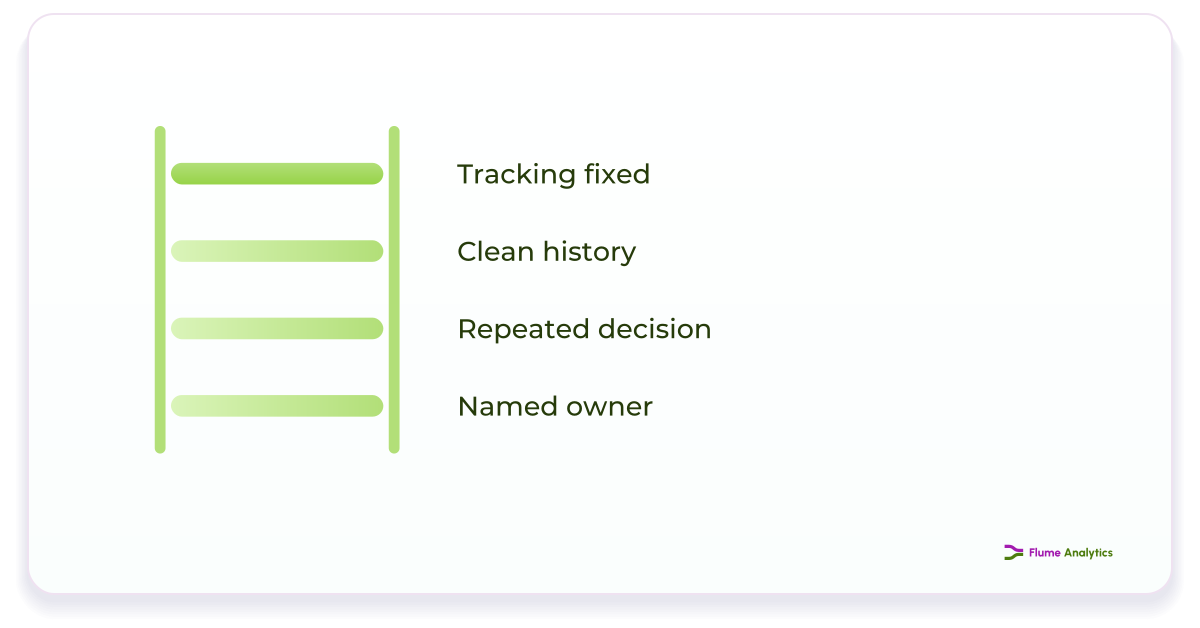
After dozens of analytics audits, the pattern is simple. Projects pay back when four things line up: a repeated decision, a measurable outcome, usable history and someone who will act on the score. Remove any one of them and the project drifts. Before you spend, run through this list:
- You make the same decision at least a few hundred times per quarter.
- You have at least a year or two of consistent history for that decision.
- The outcome you want to predict is recorded reliably, not inferred.
- A named person will act on the output and report what happened.
- Someone owns monitoring and retraining after launch.
If you tick four or five, the case is strong. Three or fewer means you probably need cleaner data or a clearer decision first. Rolling out well matters as much as choosing well, which is why my notes on predictive analytics implementation cover sequencing, delays and handover.
How to Weigh the Trade-Offs for Your Business
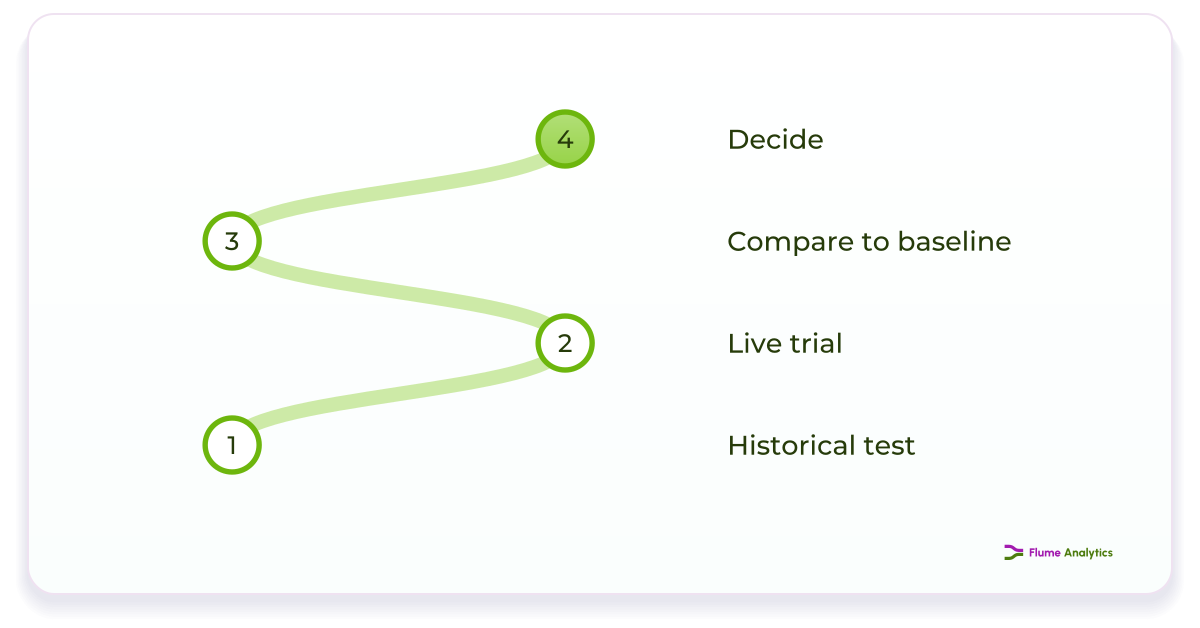
Start with one decision, not a platform. Write down what the decision is, who makes it, what they use today and what a better answer is worth. Then set a baseline: last year's simple average, a rule or a spreadsheet forecast. If a model cannot beat the baseline by a margin that pays for the work, you have your answer in days rather than months.
Run a short pilot on historical data, then a live trial where the model's output is shown but not yet required. Compare results after one full cycle. That approach keeps the downside small and gives you evidence for the larger investment. If you want an outside read, a discovery call can test your idea against these criteria before any build starts.
Sources worth reading for method: the Forecasting: Principles and Practice textbook on baselines and error measures, and Google's Rules of Machine Learning on keeping models simple and monitored.
Questions About Predictive Analytics Pros and Cons
What Are the Main Advantages of Predictive Analytics?
The main advantages are earlier warning, better targeting and measurable accuracy. You find at-risk customers, demand spikes or late payers before they affect revenue, you put limited effort on the records most likely to respond, and you can track forecast error month by month. The gain depends on someone acting on each prediction.
What Are the Biggest Disadvantages?
Data preparation, drift and explainability. Cleaning and joining data takes more time than most plans allow, models lose accuracy as behavior changes, and complex models are hard to explain to the people who need to trust them. Add the cost of an owner who monitors and retrains the model.
Is Predictive Analytics Worth It for a Small Company?
It can be, if the use case is narrow and the data is clean. A simple demand forecast or churn score built in tools you already own often pays off. A custom machine learning platform rarely does. Start with one repeated decision and a clear baseline.
How Much Data Do I Need?
It depends on the question. Many business forecasts need at least one to two years of consistent history, and classification models need enough examples of each outcome. If the event you want to predict is rare, you need a longer history or a simpler method.
How Accurate Are Predictive Models?
Accuracy varies with data quality and the stability of the thing you predict. Test every model against a simple baseline such as last year's average, and measure error on data the model has not seen. If it does not beat the baseline, it is not worth deploying.
Does Predictive Analytics Replace Human Judgment?
No. It ranks and estimates, and people decide. For decisions that affect individuals, such as hiring, credit or care, keep a human reviewer, log what the model suggested and check outcomes across groups.
How Long Does It Take to See a Return?
A focused first model on clean data can show a measurable result within one to two quarters of go-live. Projects with messy data take longer because the pipeline has to be fixed first. Judge the return after at least one full decision cycle.
Important: nothing in this article is legal, financial or tax advice. All figures are estimates from typical projects, so verify them with your own providers and advisers.
Was this useful?
We appreciate the feedback.
Rosalind Tierney
Rosalind leads the Flume editorial team and works with our consultants to turn real client projects into practical guides on dashboards, tracking, experimentation and machine learning. Before joining Flume, she spent 11 years in analytics and business intelligence roles. She has since edited more than 300 articles on analytics practice and reviewed dashboards, tracking plans and analytics audits from over 100 client projects. She is based in Minneapolis, Minnesota.